


Across Africa, 360 million people cannot access the formal banking system. Unable to obtain loans, savings accounts, and the financial tools that could transform their lives. When traditional banks see ‘too risky’ or ‘unprofitable,’ what do visionary entrepreneurs see?
For Phocas Maniraguha, growing up in Rwanda’s Musanze District, financial exclusion wasn’t an abstract concept, it was what he saw around him every day. His self-employed father in construction struggled to access the capital needed to grow his business, and Phocas witnessed firsthand how lack of financial services limited what ambitious people could achieve. Initially, this didn’t inspire entrepreneurial dreams. Like many students Phocas simply wanted a steady job and financial security.
“When I started university, things changed,” Phocas says. He decided to pursue a bachelor’s degree in healthcare management at Southern New Hampshire University and took part in a university competition centred on business ideas, and here Phocas managed to first show his knack for creativity and perseverance. Along with his team, he created a web-based platform using Canva to facilitate tutoring services for students. “People loved it”, Phocas said. “That’s when I realized that entrepreneurship could lead to good things.”
But it was a healthcare innovation competition that revealed his true calling. Inspired by the challenges he faced accessing medicine in his hometown; he developed an app that locates pharmacies with available medication. His team earned third, but most importantly, Phocas discovered something that would alter his trajectory: the thrill of creating solutions that could genuinely help people.
As he finished his Bachelor’s, Phocas took a position at the Agahozo-Shalom Youth Village in Rwanda as a public health intern and looked for a steady job. After being rejected from some of his dream opportunities, Phocas reached a turning point, “Enough is enough, why should I work for others when I know I can do this myself?”
The path to entrepreneurship proved as challenging as the problems he wanted to solve. In 2020, Phocas applied to the Jasiri Talent Investor Program as he knew the programme could help him achieve his entrepreneurial goals. Unfortunately, he did not get selected. “I felt quite sad”, Phocas confessed, “I knew that my business ideas were good.”
The rejection of his application could have ceased his entrepreneurial ambitions. Resultantly, Phocas hesitated to apply for a second time. He had just received a good job offer and felt perhaps his entrepreneurial aspirations were out of reach. But something deeper than disappointment propelled him, the same persistence he’d witnessed in his father, the same determination to solve problems others ignored. He applied a second time and successfully joined the program the following year. Against conventional wisdom, he turned away from the conventional path and plunged headfirst into his entrepreneurial dream.
At Jasiri, Phocas found more than funding. He found the co-founder who would complete his vision. Jean Luc Mushi was everything Phocas wasn’t. Internationally experienced, business-trained, and fearlessly adaptable. While Phocas brought deep understanding of local problems, Jean Luc brought a global perspective shaped by work across South Sudan, Mauritius, and Uganda. Where Phocas saw barriers people faced, Jean Luc saw systems that could be rebuilt. Together, they realized they had the complementary skills needed to tackle financial exclusion at scale.
In 2022, they founded Credit Jambo, a fintech company designed specifically for Africa’s underserved populations. Their platform provides digital micro-loans and mobile financial tools accessible via both smartphones and basic mobile phones, deliberately targeting the 400 million Africans excluded from traditional banking.
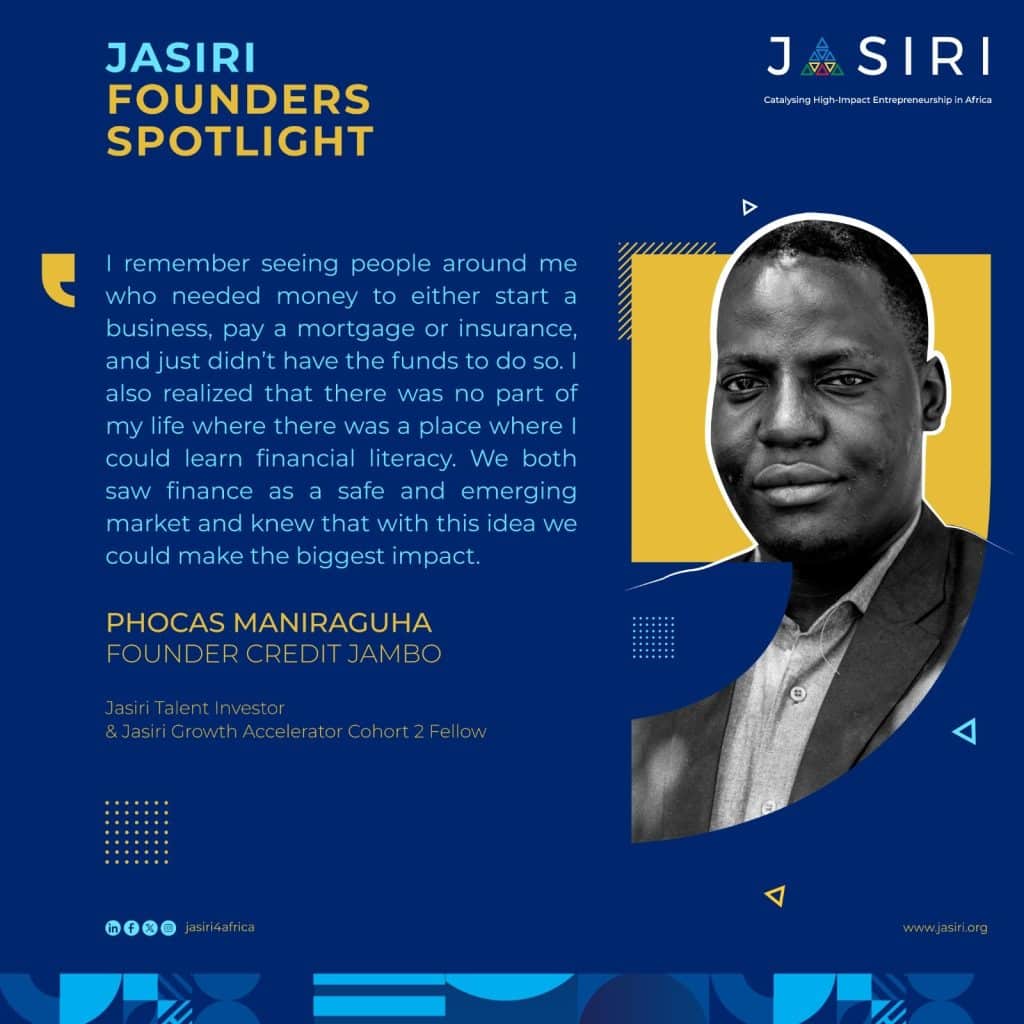
When asked what their propellant to pursue a business related to finance, Phocas stated: “I remember seeing people around me who needed money to either start a business, pay a mortgage or insurance, and just didn’t have the funds to do so. I also realized that there was no part of my life where there was a place where I could learn financial literacy. We both saw finance as a safe and emerging market and knew that with this idea we could make the biggest impact”.
Jean Luc emphasized the Jasiri Talent Programme’s role in developing Credit Jambo:
“The Jasiri Talent Programme was exactly what we needed to develop our ideas. It gave us a clear process where we could narrow down and land on a concrete idea. With every pitch day, our idea became clearer and helped us focus on how to make our idea a reality. With the 10 000USD in capital funding at the end of the Jasiri Talent Programme, we felt ready to start what would become Credit Jambo.”
Like many startups tackling systemic challenges, Credit Jambo’s early days tested their resolve. The first year was difficult, with Phocas and Jean struggling to find clients while awaiting their license. However, in October 2024, they achieved a major milestone by securing an official Regulatory Compliance Operating License from the Central Bank of Rwanda. With legitimacy established, they made strategic decisions that would define their impact. They chose to focus on the BodaBoda market, the primary mode of transport in Rwanda, by offering affordable interest rates and flexible repayment terms tailored to riders’ cash flows. Additionally, they targeted small and medium-sized enterprises (SMEs), deliberately keeping interest rates low to attract low-income business owners in need of accessible financing.
The results validated their approach to inclusive finance. By June of 2025, the company had disbursed 1588 loans, built a loan book size of 105 million Rwandan Francs, and grown its customer base to 300+ active users. Their JAMP360 Version 2 platform enhanced automation in loan disbursement and repayment tracking. This proved that technology could make financial inclusion both scalable and sustainable.
But the real measure of success lies in individual stories like Daniel’s. A Boda-boda driver, who struggled to cover essential expenses, like his kids’ school fees and healthcare insurance, causing significant stress and pressure in his life. Through Credit Jambo, Daniel received prompt access to microloans, totalling $800 across 14 loans, and repaid them seamlessly. Today, Daniel can send his kids to school on time, pay family health insurance, and has helped start a small vegetable business for his wife.
For Phocas, these individual transformations represent something larger than business success: “Our customers come and say they are thankful that our loans helped them pay off their health insurance or start their small business. It makes me emotional to know that I am making an impact.”
The vision extends far beyond Rwanda’s borders. Now, Phocas and Jean Luc are looking to scale Credit Jambo even further, reaching more communities and transforming more lives across Africa. Their journey proves that financial exclusion isn’t inevitable, it’s a problem waiting for the right solution. When many Africans are denied access to basic financial services, entrepreneurs like Phocas and Jean Luc don’t see an impossible challenge. They see 360 million opportunities to make a difference.
Leave a Reply