


When someone’s heart stops, you have approximately four to seven minutes to save them. How long does an ambulance take to reach you?
Most of us never think about that gap until we need one. Until someone collapses at a family gathering, or there’s an accident on a road you travel every day, or a neighbour starts having chest pains and suddenly those abstract response times become terrifyingly real. In those moments, you realize that “help is on the way” and “help has arrived” can be separated by the longest minutes of your life.
For Dr. Helen Gizachew and Dr. Loza Admassu, two medical school graduates from Ethiopia, that realization came dauntingly during their Jasiri residential intensive in rural Rwanda. Two people desperately needed medical attention. One seemed to be having an appendicitis attack. Helen and Loza knew exactly what needed to happen medically. What they discovered that day was that knowing what to do and being able to do it are separated by infrastructure that doesn’t exist. “We were asking locals, asking staff: is there an ambulance? Can someone help us? We couldn’t find anyone,” Helen recalls.
The gap between when help is needed and when help arrives became the problem they would spend the next years solving.
Helen grew up in Addis Ababa with a clear vision of what being a doctor meant. “I always thought, you know, I’m a doctor, then I would save lives. You think you’ll make a difference.” Medical school had other plans. “As you get more into it, you realize why most health professionals end up being depressed because it’s not the same,” she explains. “The infrastructure is very difficult to work with. There’s lack of structure, lack of supplies, materials. You, as a single person making a difference, makes it very, very difficult.”
But Helen and Loza had never been good at accepting limitations. Before Jasiri, they’d already spent years trying to solve health problems through their sexual and reproductive health podcast, recording 50 episodes during COVID to reach people who couldn’t access traditional health education. The podcast taught them something: imperfect solutions that reach people beat the perfect ones that never launch.
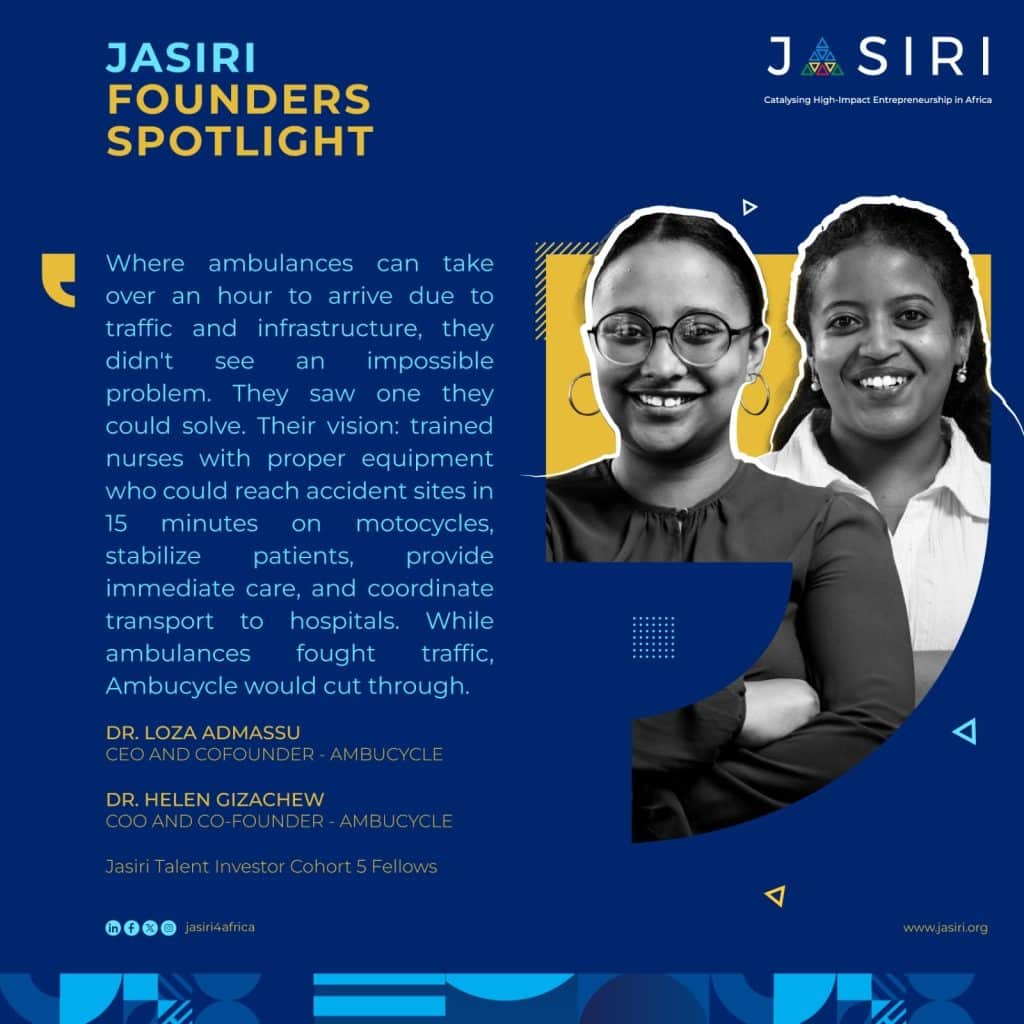
When that emergency highlighted Rwanda’s response time crisis, where ambulances can take over an hour to arrive due to traffic and infrastructure, they didn’t see an impossible problem. They saw one they could solve.
The solution, when it surfaced, was almost obvious: nurses on motorbikes. “There are many motorbikes in Rwanda, and they’re faster,” Helen explains. “Even when cars can’t reach certain areas, these people would be able to reach them. In cities, there’s a huge gap because it takes an hour, hour and a half for an ambulance to show up because of traffic.”
Their vision: trained nurses with proper equipment who could reach accident sites in 15 minutes, stabilize patients, provide immediate care, and coordinate transport to hospitals. While ambulances fought traffic, Ambucycle would cut through. Turning the idea into reality required navigating regulatory frameworks, training protocols, and government partnerships. None of which Helen and Loza had any experience with.
“We came to Jasiri with blank papers,” Helen admits. “Both of us had never had any entrepreneurship formal lessons. All we knew about business basically comes from Jasiri training.”
What followed was institutional buy-in. The Ministry of Health believed in them. Rwanda’s emergency medical response system, SAMU, signed a collaboration agreement. The National Police cleared their nurses to exceed normal speed limits during emergencies. Since their pilot, Ambucycle has served 73 patients. Most of the responses dispatched to accident victims. Two cases changed how they thought about what they were building. Their nurses delivered two babies for mothers who couldn’t reach hospitals in time.
“The first time it happened, we were very shocked,” Helen laughs. “We even had limitations: maybe they shouldn’t be dispatched for obstetric cases. But our nurses did really, really well. These women would have delivered without any attendant at their homes. We saw the value in being there, someone with knowledge, the right tools, the right connections.”
Each successful response validated their core insight: in emergencies, the difference between help and no help isn’t just medical, it’s logistical. Getting skilled care to people faster is integral.
If one were to ask Helen about entrepreneurship now, her answer would reveal how much has changed since those “blank paper” days at Jasiri. “I thought I was not cut out for business anyway. I’m someone doing academics, and it’s very unlikely to do business,” she reflects. “But I learned that businesses don’t always have to be something unimpactful. You can still do impactful things, and actually it’s very good for sustaining these impactful things.”
Her new definition of entrepreneurship is refreshing: “Finding things that solve people’s problems that people will pay for so it can continue.” That sustainability piece matters. Before Ambucycle, Helen and Loza’s health initiatives were volunteer projects. “It’s about finding the right things to do so people will willingly pay, because I know myself, I’ll pay for anything that will solve my problem.”
Now, they’re partnering with insurance companies to integrate emergency response into healthcare coverage.
Building Ambucycle hasn’t been straightforward. “In reality, there are multiple challenges,” Helen explains. “Things you’re assuming will work become very complicated. There are things that are required that take a very long time to get, things that don’t just depend on you but depend on the environment.”
What kept them going was their partnership, eight years of friendship and collaboration that became their “superpower.” Living together, communicating constantly, supporting each other through setbacks. “We learned that we are very persistent,” Helen says. “Once we believe in something, we push to the very end. We always say we didn’t come this far to only come this far.”
Today, Ambucycle is scaling up, preparing to train 50 new responders and expand beyond Kigali to reach the remote areas where emergency care is most desperately needed.
Helen’s vision for success operates on two levels: “Somebody at a very vulnerable moment would say, somebody will come to me fast, so let me call them.” But she also thinks bigger: “In the grand scheme of things, regarding emergency medical systems in the whole of Africa, being able to be one of the major emergency service providers in Ethiopia, Rwanda, and Kenya would have a very impactful measure.”
The plan includes helicopters for mountain rescues, expanded fleets, and coverage across multiple countries. “Even the fact that one person is saved, it has some difference in the world for us. You can make a difference to the person next to you, and that will have a grander effect on the world.”
Two young medical doctors could have looked at emergency response systems across East Africa and seen an impossible challenge. Instead, they figured out how to reach them faster. The difference wasn’t just medical training or entrepreneurial education. It was the willingness to start with what they could control: one motorbike, three trained nurses, and a simple belief that help should arrive fast.
In a world where the gap between problem and solution often feels insurmountable, Helen and Loza proved something powerful: sometimes the most sophisticated solution is getting the right person to the right place at exactly the right time.
For Ambucycle, they are just 15 minutes away.
[NM1]@Wamuyu please could you offer assistance with their surnames? If you have them, that is.
Leave a Reply