

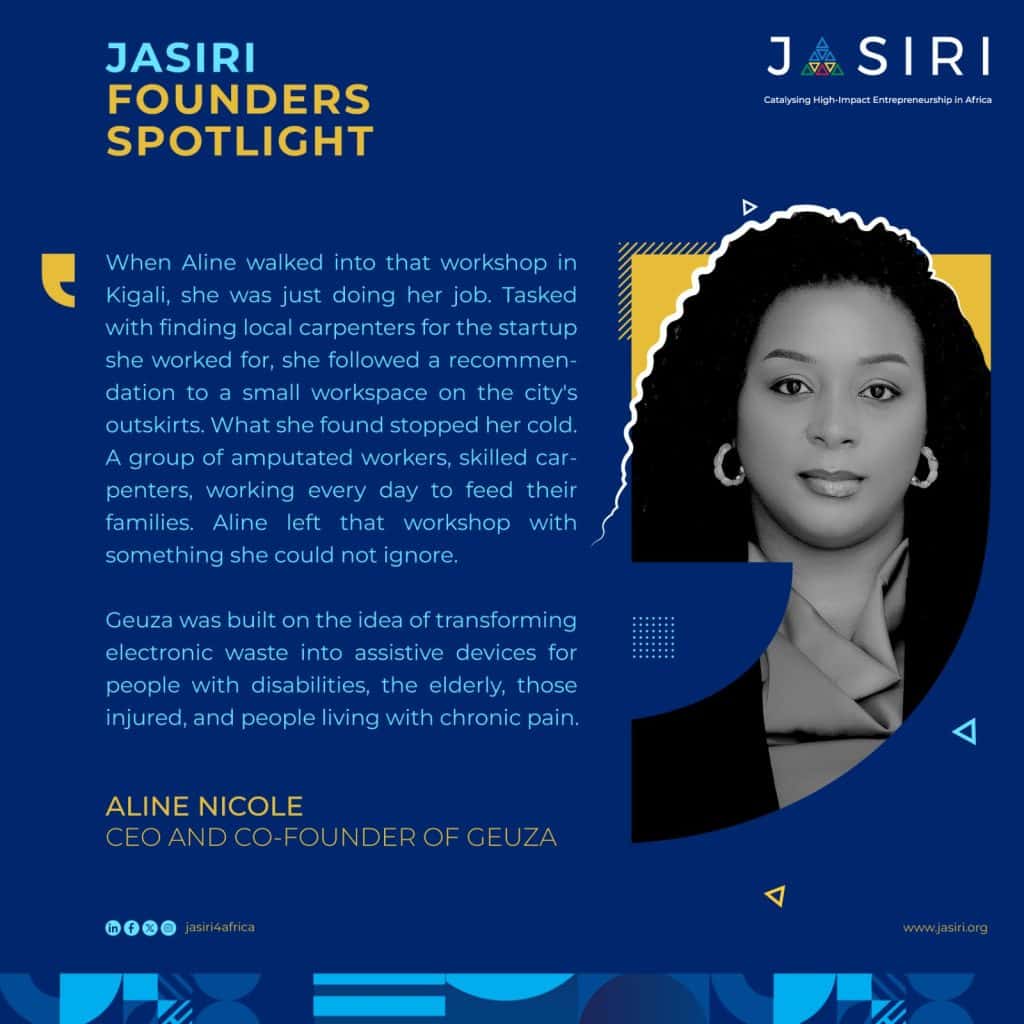

When Aline walked into that workshop in Kigali, she was just doing her job. Tasked with finding local carpenters for the startup she worked for, she followed a recommendation to a small workspace on the outskirts of the city. What she found stopped her cold. A group of disabled workers. Some moved on wooden crutches that splintered with use, balancing precariously as they tried to work. When they stood, they could barely stay upright or they risked injury. Yet, they smiled. They worked. They provided for their families.
The moment almost broke her. Not because of what she saw, but because of what she couldn’t do about it.
Aline stayed with them for a while, listening to their stories. How they got wounded easily because they lacked proper equipment. How even basic wheelchairs felt like impossible luxuries. In what she now calls a “privileged thought,” she asked them: “Well, you’re working—why don’t you buy wheelchairs or better crutches?” They laughed at her. The way you laugh at someone who means well but doesn’t understand. They told her the math of their lives: every franc they earned went toward feeding their families, toward shelter, toward keeping their children in school. Mobility devices weren’t an expense they could consider.
“I couldn’t hire them,” Aline recalls. “The work required too much movement, and they could barely stand.”
She left that workshop with something she couldn’t unsee: a room full of people working harder than anyone she knew, held back not by their will but by the absence of tools most of us never think about.
Aline grew up in Rwanda in what she describes as “a safe space, in security.” A space that gave her the tools to innovate, to find problems in society, and the support to solve them. From her family, she learned to always lead with integrity, to be humble, to treat everyone the same no matter their social or financial standing. Before entrepreneurship, she thought a good life simply meant being healthy and wealthy enough to provide for herself and her loved ones. She had a stable job. She was a mother and a wife. She wasn’t looking to disrupt anything.
But that workshop visit planted something. And then her boss at the startup said something that would echo later: “If we work together for three years, you won’t need to work with anyone else.” At first, Aline didn’t understand. Then she realized what he meant: she was doing most of the work anyway. “After my first year, I started thinking: why can’t I start my own startup?” But fear held her back. As a mother with a family depending on her, she didn’t have the confidence to leave stability for the unknown.
Then a friend mentioned Jasiri. They made a pact: her friend would apply first, test if it was legit, and if it worked, Aline would follow. Her friend got in. The next cohort, Aline applied. Her family thought she was crazy. “They were really scared for me. They kept asking: how long until you get stable pay? How long until you’re successful?” But a mentor who had always believed in her pushed her forward: “If you can do it for someone else’s startup, why won’t you do it for yourself?”
The venture she built is called Geuza—a Swahili word that translates to “Transform.” And transformation is exactly what it delivers. Geuza takes electronic waste and transforms them into mobility and assistive devices for people with disabilities, the elderly, those injured, and people living with chronic pain. Geuza also integrates IoT sensors into their devices to track movements and postures, collecting data for rehabilitation centers and physical therapists.
“Honestly, I don’t think I would have created this had I not joined Jasiri,” Aline says. “There are so many aspects of entrepreneurship and business creation that I wouldn’t have known about otherwise. Value proposition. Knowing how to show the ‘why‘ of your business. Creating a business plan. I knew I needed skills to start a business, but without Jasiri, those skills would have been much harder to learn.”
What started with amputee crutches has grown to include elbow crutches and wheelchairs. Geuza entered the market in December 2025, and the feedback from customers has been overwhelmingly positive. They work with hospitals, orthopedic clinics, pharmacists, and rehabilitation centers—building relationships with smaller customers first because, as Aline explains, the health sector doesn’t make it easy for newcomers. “There are other service providers that have been operating for over 20 years, approved long ago to be official partners of local hospitals. It’s hard to prove yourself because not enough people take a chance on you when you’re new.”
But Aline’s impact reaches beyond her own venture. In Rwanda, no other company is turning electronic waste into assistive devices. That puts her in a unique position—one that policymakers have started to take notice of. She now sits alongside government stakeholders, helping shape the very regulations that will govern this space. What began as a mission to help a few workers in a workshop has quietly grown into something larger: Aline is helping rewrite the country’s healthcare policies on assistive devices.
When asked if she ever considered quitting, Aline’s answer was immediate: “Never. It has never crossed my mind.” She pauses, then elaborates: “I am a very determined person.” When I venture into something, I don’t quit unless I am completely drained and exhausted. That point hasn’t happened, and hopefully it never does.” But that doesn’t mean the journey was easy. The challenging part of the Jasiri program, she says, was finding the right people to build with. People come with different backgrounds, values, and beliefs, and not every partnership is meant to last. But the determination and vision that she and her cofounder shared pushed them to learn how to put at center what’s important and leave behind what could lead to distractions.
Since Jasiri, Aline has secured three fundings. In 2024, she placed second in the Hanga Pitchfest Competition—with only a prototype. “This proved to people watching—investors, future customers—that our work was important, even before we’d sold anything.” Her second funding came from Timbuktu Health Tech, which helped develop the IoT prototype and connected her with other innovators across Africa. Her most recent funding, from Carnegie Mellon University’s Entrepreneurship Program, helps keep the company afloat while they build.
When asked who has been impacted by Geuza, Aline said: “First, my team. I have a great team that I have the privilege to be able to provide with a stable income.” Then the customers—the pharmacists, doctors, and rehabilitation professionals who use Geuza’s devices to help their patients. And then, finally, the end users themselves. “We see how these patients are touched by the simple fact that we facilitated their day-to-day movements,” she says. “For some, they are unable to leave the house. Those who can leave do so in pain because they have defective devices. Being able to change their lives completely by simply providing these devices—it’s something my team and I always cherish.”
The health sector remains challenging. Regulations require money to navigate. Government approvals take time. Competing with companies that have decades of institutional trust is an uphill battle. But Aline keeps showing up. “Everyone tells you entrepreneurship will be complicated. But you never realize how much until you enter the field. Every day is different. Today can be great; tomorrow will be the hardest day of your life. You could have a whole week of bad days, and the next month will be the easiest you’ve had. It’s unpredictable.” The pressure is constant: How do I pay my employees? How do I not let down my suppliers? Where do I find funding to keep scaling? How do I get the government, my clientele, and stakeholders to believe in me while meeting their expectations? “I have always said I’m determined and I like challenges. But nothing has ever challenged me like venture building has.”
When she thinks about young people considering entrepreneurship, her advice is direct: “Do it. There are a lot of problems in our society that need fixing, and we shouldn’t wait for the next person to fix them. This is also a great opportunity to gain skills; even if you don’t succeed in building a business, the skills you learn can be used in so many other places and make you a more knowledgeable person.”
Aline’s vision for Geuza extends far beyond where she started. “I dream of opening shops in more places. Not only in Kigali, but nationwide. I want to feel like we are really transforming people’s lives—giving them more accessible and more affordable means of mobility.” She thinks about those carpenters often. The ones she couldn’t hire. “I want to reduce those disadvantages as much as possible. 15% of the population globally have physical disabilities, and half of them don’t have access to assistive devices. I want to help some of those people. I want them to not worry that their financial status will hinder their ability to get the devices they need.”
On the hardest days, when the regulations seem endless and the funding feels uncertain and the weight of being a founder presses down, Aline has a simple practice: “I always tell myself, tomorrow will be a better day. I seek support around me.” But there’s something else too. Something she said earlier, about that workshop full of workers who smiled through their struggles, who were grateful just to work. “I think of them,” she says. “I think of all the people like them. Everyone has the ability to solve a problem, and entrepreneurship is the key to solving those problems. It’s fascinating, and there’s a maturity and growth that comes with it that you wouldn’t get anywhere else.”
Geuza means transform. And transformation, Aline has learned, doesn’t happen all at once. It happens with one device, one patient, one impossible day at a time. For the carpenters she couldn’t hire, for the patients who can now leave their homes, for the team she supports, and for everyone who ever thought mobility was a privilege they couldn’t afford—Aline is transforming what’s possible. One crutch. One wheelchair. One life at a time.
Leave a Reply