

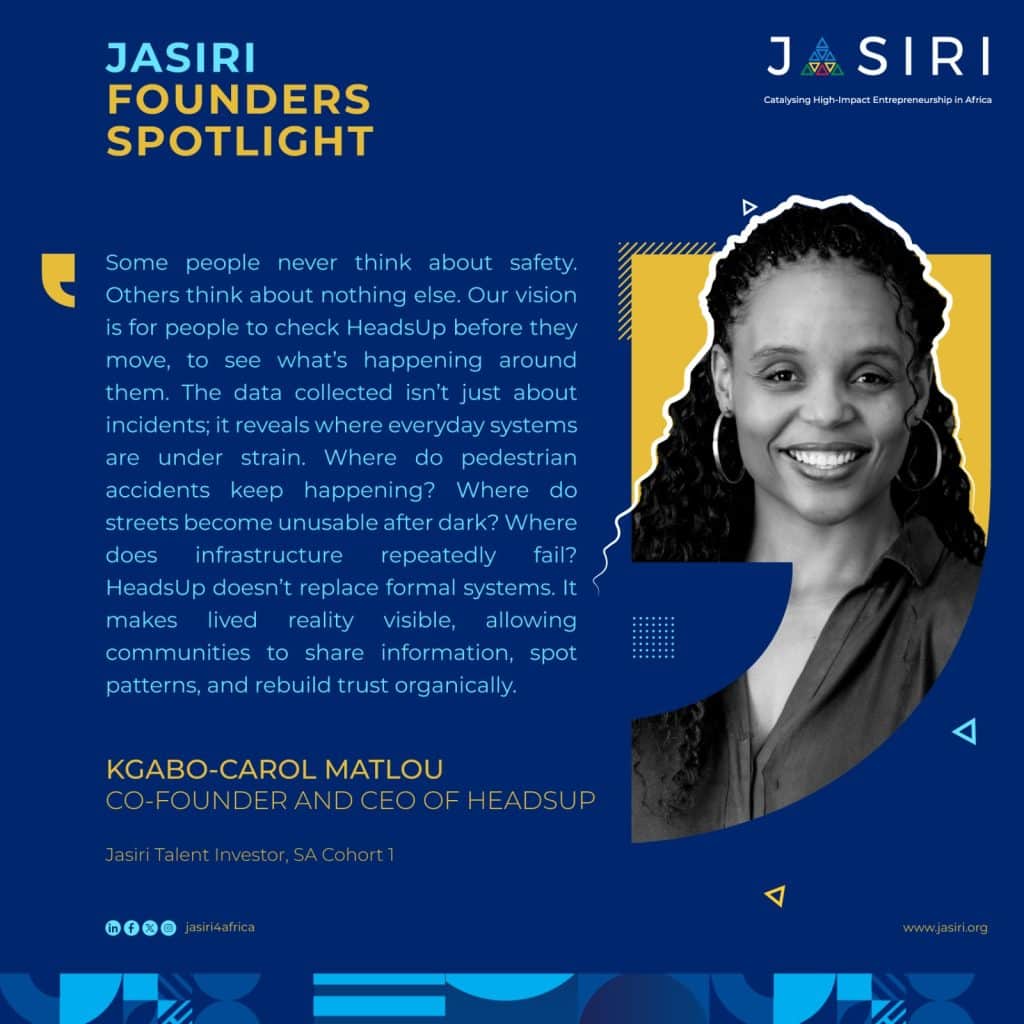

Some people never think about safety. Others think about nothing else.
Without it, a child stops walking to school alone. A woman calculates the safer route, the one that adds twenty minutes but keeps her in lit spaces with witnesses. An entrepreneur watches the clock and closes early, leaving money on the table because staying open after dark isn’t worth the risk. Neighbours stop greeting each other. What was once a community becomes a collection of strangers moving through shared space with clenched teeth and averted eyes.
This is the invisible tax of fear. It takes peace, certainly, but it also steals the things that make life worth living potential, spontaneity, the capacity to trust a stranger walking toward you on an empty street.
When was the last time you walked home after dark without looking over your shoulder? When did you last trust the stranger walking toward you on an empty street? What would your life look like if you felt genuinely safe the moment you stepped outside your front door?
Kgabo-Carol Matlou is building the answer to that question.
Years ago, long before she understood what building a company meant, Kgabo-Carol’s school couldn’t field a proper netball team. The struggle repeated itself every season, becoming an accepted limitation rather than a problem worth solving. She refused to accept it. “I organized the whole thing, put it together per team, and we did it. Netball has been a challenge every year, and I’m very proud of that. I left a mark.”
Something clarified itself in that moment. “I realized that whatever I put my mind to, I actually get it done, and I’m actually good at engaging people to come together for a common cause.”
But growing cognizance of one’s leadership abilities and building something sustainable, however, are two different journeys. Before Jasiri, Kgabo-Carol had launched Mina, a logistics brand born from necessity and hustle. “The business was bootstrapped. I had no sort of help from anyone, no funding, nothing.” What followed was a patchwork existence. One entrepreneurial program provided books. Another offered office space. A third contributed mentorship. “I patched those types of support together in trying to maintain and grow the business.”
It was at one of these programs that she saw the poster. Jasiri. Applications open. She treated it like she’d treated everything else: another resource to explore, another program to join. “I honestly just thought it was one of those programs that I’m always a part of, and I just applied.” The selection process shifted her perspective. “It was really through the application process that I realized this might be different. This is not like everything else that I’ve done.” When acceptance came, she started researching what she’d actually signed up for. “I started doing my research. What is this thing I got myself into? Looking at the fellows from East Africa, the work that they’ve done, and I was just like, oh my God, what did I get myself into? Am I really ready for this?”
Nonetheless, Carol took the plunge and made a decision that would fundamentally re-write Divine decree. She moved her three boys to her parents’ house, put all her belongings in storage, and prepared for Jasiri’s three-month residential intensive. “It was literally just for the three months. It felt like new beginnings for myself, and that’s exactly what it was. That’s what made the journey for me so pure because I really got myself into it fully.”
What she discovered there changed her understanding of what she’d been trying to build all along “I had no idea that there was a science behind business, and what it actually is.” Looking back at her previous ventures, the reason for their failure became conspicuous: “I didn’t do it the right way. And there is a way of doing it, and that way is what we’ve been learning: systems thinking, looking at the broken systems, finding out what’s the root cause, feasibility and viability of your intervention.” Previously, she had been solving challenges intuitively. Jasiri taught her to tackle them systematically.
The venture that emerged from this new way of thinking started with a conversation.
She posed a question to her co-founder: “What makes this space feel so safe, and what does safety mean?” They took the question to the streets, asking people directly: What does safety mean to you? Do you feel safe? Why don’t you feel safe? What would make you feel safe? The responses revealed a gap that shouldn’t exist: “People feel safe inside their own home, and the moment they step out, that safety goes away. Security systems have been designed for your home or for your car, but nothing exists the moment you step out.”
That’s how Heads Up was born. Community members share and receive real-time safety alerts through WhatsApp. “Members can find safe local spots and trigger SOS alerts if something happens.” But the mechanics alone don’t explain what drives the platform. The deeper philosophy came from an unexpected source: a community expert named Vuyi from Philippi Village, one of South Africa’s most dangerous townships. “He taught us that visibility and community connection are the real foundation of safety. He built trust through presence and openness.” When people jumped a wall into his space, he didn’t respond by building it higher. “He turned that space into a recreational area, a skate park, benches, graffiti walls where people can take pictures, so there’s always visibility or presence in that space.”
That philosophy now drives Heads Up. “Our vision is for people to check Heads Up before they step out of the house to see what’s happening around them.” The data they collect isn’t just about crime; it’s about building a map of where systems are weak. “Where are recurring pedestrian accidents? Where do robberies happen in dark spaces that need lighting and surveillance? Where is the signal weak?” And importantly: “According to our research, people don’t report incidents because they’ve lost trust in the police. They’ll only report if something huge happens.” Most people don’t report a stolen phone because “there’s really nothing the police can do about it, or they’ve lost trust in the police.” Heads Up offers an alternative, a way to map danger, share information, and rebuild trust within communities themselves.
The journey hasn’t been easy. After the intensive, reintegration was hard. Additionally, her co-founder lives seven hours away, which creates its own operational challenges. “That shift from working together under the same roof every day to being seven hours apart, he comes once a month, and we push through everything that needs to happen.”
Despite the challenges, Kgabo-Carol keeps going because the model is proving its significance. They’ve recruited five agents on the ground who share incidents in real time. In two months, they’ve received 23 incident reports and built a community of 1,143 early-access members. They’re piloting with university students, “the most vulnerable because they move from home into a new space, they’re not familiar with it, they’ve lost that community from their neighbours and family.”
The vision is bigger than an app. “Heads Up isn’t just a safety platform. It really feels like a movement of awareness, trust, and community. My co-founder and I believe that once community trust has been rebuilt, then other forms of growth can thrive, whether it’s social, economic, or cultural. Safety depends on community trust, and that’s the need.” They’re starting small, “one neighbourhood at a time, through testing, learning, and growing organically.” But the dream? “To become the go-to community safety layer across Africa, powered by people, grounded by trust, and driven by shared humanity. Because really, when communities can trust each other, that’s when real magic happens.”
The young girl who once organized a netball team is still organizing, just at a different scale. “I’d be very happy and feel like I’ve reached my goal if that safety layer has been formed.” The foundation that turns strangers back into neighbours. The infrastructure that makes the shorter route the safer one.
She’s not asking for much. Just the space between your front door and the world to feel like it belongs to you again.
Leave a Reply