

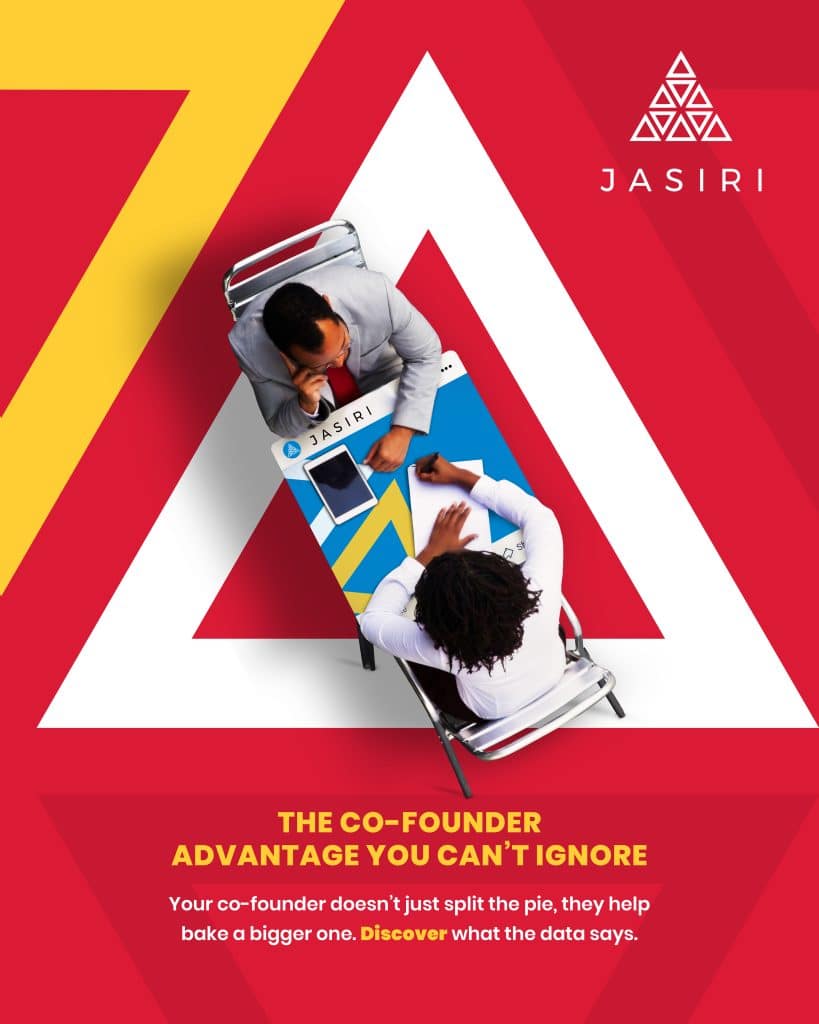

The thought leadership article explores the reality of venture creation with a co-founder, rooted in data from both global and regional perspectives.
Short Version
All founders want to build ventures that last. To achieve long term success and scale, your team structure matters just as much as your business model.
Research shows that founding teams are better equipped to handle the complexities of business especially in emerging markets. They bring different perspectives, share accountability, and bring a larger network to the table.
At Jasiri, we see this play out in every cohort: teams that collaborate effectively are the ones that go on to build stable ventures that stand the test of time and an unforgiving market.
Let’s dive into the numbers that prove why building together is the smartest strategy for future-proofing your startup.
Here is the hard truth:
Founding teams raise two times more 2.3x MORE capital than solo founders.
Teams grow 3x FASTER in user adoption and revenue.
Over 85% of funded African startups have 2 or more founders.
Solo founders face significantly greater challenges securing Series A due to key-person risk.
Why the discrepancy?
Because building a venture is a marathon, not a sprint. Especially in emerging markets.
Psychological Safety
A co-founder is a sounding board, a strategist, and a mirror. When one founder doubts, the other reassures.
Complementary Skills
One builds, the other sells. One dreams the other executes. Division of labor prevents burnout.
Investor Confidence
In Africa, where infrastructure challenges are higher, a team signals resilience.
Solo founders, we see you! You are making moves.
But to the investors and ecosystem players: When you see a strong founding team, know that the odds are statistically in their favor.
At Jasiri, we don’t just invest in businesses; we strengthen founding teams. We believe the right co-founder doesn’t split your pie, they help you bake a bigger one.
Long version
The Silicon Valley lore of a solo genius single-handedly disrupting an industry is a compelling narrative. But we believe that while that story makes for a great biography, a founding team makes for a stronger business. This holds true whether you are building in San Francisco, Kigali, or Cape Town.
For investors, ecosystem players, and aspiring founders, it’s important to understand the reality of solo vs. multi-founder startups.
The Global Standard: Survival of the Fittest
When we look at aggregate performance across international markets, the advantage of having a co-founder becomes clear.
According to research from the Founder Institute, which tracks thousands of startups globally:
- Startup teams raise 2.3x more capital than solo founders. Investors perceive teams as lower-risk because the “bus factor” (what happens if the founder gets sick or burns out?) is mitigated.
- Teams demonstrate 3x faster growth in customer base and revenue. This is often due to the division of labor. One founder can focus on product while the other focuses on go-to-market strategy.
- CB Insights’ analysis of Unicorn companies reveals that less than 15% were solo founded.
African Context: Why Teams Matter Even More Here
While the global data paints a clear picture, the African startup ecosystem presents unique challenges that make the co-founder advantage even more critical.
Infrastructure gaps, regulatory hurdles, and sometimes fragmented payment systems require founders to wear multiple hats; doing it alone is much harder.
According to annual reports from Disrupt Africa:
- Over 85% of funded African startups have multiple founders. Venture Capitalists on the continent are increasingly wary of “key-person risk” associated with solo founders.
- Solo founders in Africa often struggle to cross the Series A threshold. Investors view a founding team as a management safeguard, ensuring continuity if one leader steps away.
- In markets with higher volatility, a co-founder to share the weight with is not a luxury; it is a survival mechanism.
Beyond the work load, there is the human element. Building a startup is an emotional rollercoaster.
A Harvard Business Review study on founder conflict noted that while co-founder disputes are a leading cause of startup failure, the absence of one often leads to burnout. A co-founder provides:
- Different perspective: Spotting blind spots before they become costly mistakes.
- Sounding board:Sharing the burden of bad news from investors or clients.
- Accountability: Ensuring momentum continues even when motivation dips.
At Jasiri, we see this firsthand. The teams that progress furthest aren’t always the ones with the flashiest venture but they are the ones with the strongest founding team .
The Investor Perspective
For investors and players in the ecosystem, the “solo founder” tag can trigger additional due diligence. It’s not that solo founders won’t succeed; it’s that their odds are stacked.
When you invest in a team, they are investing in:
- Redundancy: If the CEO falls ill, the CTO can keep the lights on.
- Network: Two founders bring two distinct networks of talent, partners, and customers.
- Validation: Finding a co-founder is the first sale a founder makes. It proves they can convince great talent to join their vision without a paycheck.
To the founders reading this; if you are building alone, ask yourself what are you protecting? The right co-founder doesn’t split your pie; they help you bake a bigger one.
To the investors; look for the teams that argue well, complement each other’s skills, and share a unified vision.
At Jasiri, we are committed to supporting not just ideas, but the teams behind them. Because in the startup ecosystem both globally and locally. The strongest unit isn’t the individual, it’s a partnership.
Reworked Version
Title: The Co-Founder Advantage You Can’t Ignore
Most founders aspire to build ventures that last. To achieve long-term success and scale, your team structure matters just as much as your business model. While studies show that co-founder disputes are a leading cause of startup failure, the benefits of having a strong founding team far outweigh the risks of going solo. A co-founder brings complementary skills, diverse perspectives, shared accountability, and a larger network, equipping your venture to navigate complexity, especially in emerging markets.
At Jasiri, we see this play out in every cohort: teams that collaborate effectively are the ones that go on to build stable ventures that stand the test of a demanding market.
When we look at aggregate performance across international markets, the advantage of having a co-founder becomes clear. According to research from the Founder Institute, which tracks thousands of startups globally:
- Founding teams raise 2.3x MORE capital than solo founders.
- Teams grow 3x FASTER in user adoption and revenue.
- Over 85% of funded African startups have 2 or more founders.
- Solo founders face significantly greater challenges securing Series A due to key-person risk.
African Context: Why Teams Matter Even More Here
Building a startup is an emotional rollercoaster, and in Africa, this intensity is amplified by the environment founders operate in. The African startup ecosystem presents unique challenges that make the co-founder advantage even more critical.
From infrastructure gaps to regulatory hurdles and fragmented payment systems, founders are often required to wear multiple hats. In this context, the co-founder advantage isn’t just helpful, it’s critical.
Psychological Safety
A co-founder is a sounding board, a strategist, and a mirror. When one founder doubts, the other reassures.
Complementary Skills
One builds, the other sells. One dreams the other executes. Division of labor prevents burnout.
Investor Confidence
In Africa, where infrastructure challenges are higher, a team signals resilience.
Solo founders, we see you! You are making moves.
But to the investors and ecosystem players: When you see a strong founding team, know that the odds are statistically in their favor.
At Jasiri, we believe strong teams are at the heart of successful venture creation. Through our programme, we support Fellows in building this foundation by helping them develop a deep understanding of their strengths, motivations, and working styles, while learning how to align with others to form values-driven, competency-diverse teams. We do this through a structured yet organic team formation process that blends both guided and unstructured interactions. Recognizing that team formation is not immediate, we treat it as an iterative journey, encouraging Fellows to test, adapt, and refine their partnerships until they find the right fit.
Leave a Reply